Showing posts with label brake. Show all posts

Tuesday, May 29, 2012

The Face of Jesus in Matt’s Saddle Bag

Look!  I think I see the face of Jesus.  Like the shroud of Turin, inside his saddle bag, the spare tube and Allen wrenches were wrapped in a tie-dye-esque aged rust stained cloth.  I unraveled the wrenches and held out the cloth.  Behold!  That might fetch a few bucks on eBay.  They’ve been in the seat bag a long time, not quite B.C. old, but maybe before Bieber.  25 miles from home, I was helping Matt from Smitty’s Cyclery in Cincinnati replace a broken shift cable.  Yes.  He carries a spare.

Wrapping your tube and tools are just one of the lessons I learned from Big Matt’s saddle bag.  A former racer on the track and on the road, I’m sure Matt’s no stranger to weight weenie tendencies.  Matt proved you can pack a lot and still pack light.  The bag was packed with the expertise of an Everest climber, the necessities of survival in a few cubic inches.  I’ve had a day to think about it, and there’s not a mechanical incident that would’ve had Matt calling for a ride home.  Inside Matt’s saddle bag: tube, mini-tool with chain breaker, select 4-5-6 Allen wrenches, patch kit, brake and shifter cable, a five spot, a zip tie, and a chain pin.  I wouldn’t doubt there were a spare cleat and/or bottle cage bolt in there somewhere.  He kept the mini pump in his jersey pocket.

The black thing is the free hub body.
Matt explained the zip tie was in case your free hub body dies.  The free hub body is the thing your cassette rides on.  Its ratcheting pawls allow you to coast and engage the gears.  When it dies, and they do occasionally, you’re left…coasting home.  To fix on the fly, you can zip-tie the cassette to the spokes and get yourself home in a fixed-gear sort of way.  A zip tie can also fix a broken bottle cage, keep a busted derailleur out of your spokes or can be traded to the locals for corn and beads.

Wrapping your spare tube and tools in cloth accomplishes two, three, maybe four things.  For one, it prevents you from being the annoying Mr. Jangly Bag on group rides.  Two, it keeps sharp edge tools from serrating your spare tube.  Three, I would hedge a bet that it keeps spare tubes from drying out and/or prevents the valve-tube junction from becoming oxidized.  Lastly, it never hurts to have a rag for sweaty hands or keeping gooey chain greased hands from messing up white bar tape.

The black thing is a zip tie.
While Matt worked to get the broken cable end out of his shifter, I reached over his bike and undid the fixing bolt on his Dura Ace rear derailleur.  Matt’s got many miles in his legs, no stranger to being 2 hours from home with a mechanical.  He’s a mechanic at Smitty’s Cyclery in Cincinnati.  Yet even he packs a spare derailleur cable and a spare brake cable in his seat bag.  I scratched my head.  His Land Shark bike was impeccably clean and well maintained.  Having worked at a shop myself, I take pride wrenching on my own bikes and used to have a relative comfort in thinking that my cables are new and all bolts are properly fixed.  I don’t need to bring a multi-tool or anything beyond a tube, cartridge, mini-pump and five-dollar bill.  There on a flat road, 2 hours from home, Matt snapped a cable, fixed it with a spare in the span of 5 minutes and left me questioning my minimalist logic.

Monday, February 7, 2011

U Pull & Save on Used Campy Record 10

At Joe Biker's "You Pull And Save" you can snap up Campy Record 10 Components for cheep cheep! We don't put on the chicken suit for nothing! Best of all we pulled all the parts off the bike for you, so all you have to do is buy 'em for cheep cheep. Get it! It's Campagnolo Record 10, made by an army of meticulous organic Lasagna-fed Italians and christened in 100 percent pure Grappa. Snap it up now for cheep cheep from a reliable mechanic slash bike dork in a chicken outfit slash gosh darn good guy before it goes up on eBay where I will milk it for every penny it's worth and charge astronomical amounts for shipping. Kidding. Here are the pure bike porn goodies:


Campagnolo Record 10 Carbon Fiber Ultra Shift Levers
Ergopower design. Right hand shifter rebuilt in Summer 2010. Clean, smooth working condition, slight cosmetic wear on top of hoods, lightweight. Shifters allow multiple up/down shifts with one throw of lever. Don’t worry about cross gearing, left shifter has multiple trim stops for quiet shifting and multiple gear options. Campy box included.

Asking $200 ($10 Shipping in Continental US Only, Accept Pay Pal or Cash, click here to email for inquiry or more information) 


Campagnolo Record Carbon 10 Speed Clamp-on Front Derailleur 34.9mm 
Carbon/Ti. Can be shimmed down to 32mm with Ti shims available at your local bike shop to fit and spread clamping force on 32mm carbon seat tube. Campy box included.

Campagnolo Record Carbon/Ti 10 Spd Short Cage Rear Derailleur 
The body is titanium, and the parallelogram and cage are carbon fiber. 189g. Short cage is standard for most road bikes, 57mm axle to axle. Campy box included.

Asking: $135 ($10 Shipping in Continental US Only, Accept Pay Pal or Cash, click here to email for inquiry or more information)

Campagnolo Record Titanium 10 Speed Road Brakeset 
Great feeling modulation. Front brake rebuilt with new pads, spring and hardware in Fall of 2010. Clean. Campy box included.

Asking: $90 ($10 Shipping in Continental US Only, Accept Pay Pal or Cash, click here to email for inquiry or more information)

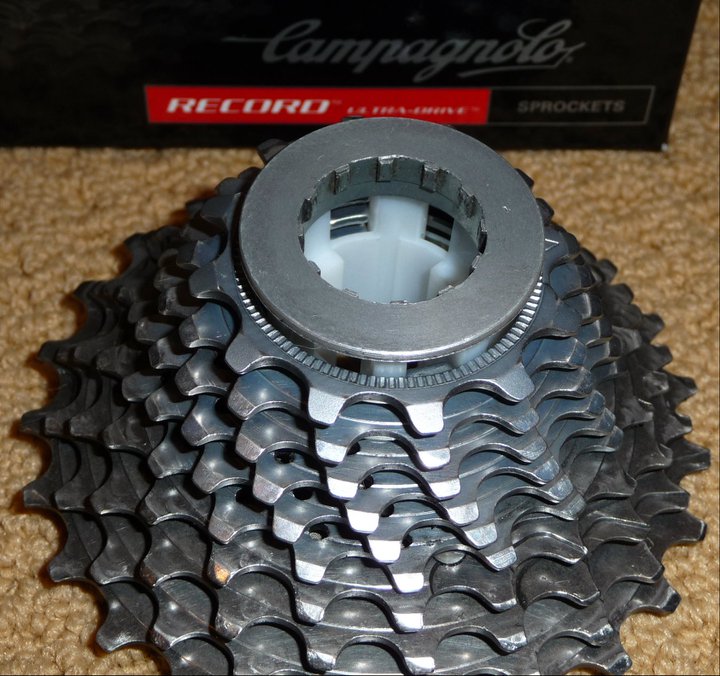
Campagnolo Record Titanium 12-25t 10speed cassette/cogs & Chain 
Practically brand new. New in Summer of 2010. Largest four cogs are Ti. Campagnolo steel lockring. 215g. 12-13-14-15-16-17-19-21-23-25T. Includes: Campagnolo Record 10 Chain purchased same time as cassette (pictured at bottom). Campy drilled for super lightness. Cut to fit 50/34-12/25 Compact Gearing. Campy boxes included.

Asking $125 ($10 Shipping in Continental US Only, Accept Pay Pal or Cash, click here to email for inquiry or more information)

FSA Pro Road Chainring 50t Big Ring for Compact Gearing 
New in summer 2010. 10, 9 or 8 speed compatible. Fits FSA, Shimano, Truvativ and other non Campagnolo cranksets. Ramped and pinned for super smooth shifting. CNC black anodized 7075-T6 Aluminum. FSA packaging included.
FSA Pro Road Chainring 34t Inner Ring for Compact Gearing 
New in summer 2010. 10, 9 or 8 speed compatible. Fits FSA, Shimano, Truvativ and other non Campagnolo cranksets. CNC black anodized 7075-T6 Aluminum. 34g. FSA packaging included. 
Campagnolo Record 10 Chain 
Purchased same time as cassette (pictured and included with sale of cassette above). Campy drilled for super lightness. Cut to fit 50/34-12/25 Compact Gearing. Box included. 

Wednesday, December 15, 2010

Home Mechanic: Magic Juice May Outlast Patience

"Magic Juice" Should Be On Every Bike Workbench
Riddle me this.  You have a good sized credit card limit, a new brake cable, a u-shaped thingy, a brake spring, a 3-month gym membership including unlimited spin classes, and a bottle of penetrating oil that the mechanic at your local bike shop refers to affectionately as magic juice.  In what order do you use these tools to fix a 2004 Campagnolo Record front brake two weeks before Christmas when the high temperature is in the single digits?

Answer: Not in the order I did it.

Two weeks ago Blue Legs and her gorgeous, intelligent, super fit teammate, who looks like she’s in her mid 20’s set out for a Saturday ride.  It was a quick but hilly loop on a Northern Kentucky rolling favorite, Amsterdam Road.  Prior to bombing Amsterdam’s descent back down to the Ohio River, non-Blue Leg's front brake broke. 

Blue Legs
They pulled over.  The lever was in need of Viagra, limp and lifeless.  A broken cable, she reasoned.  Being the super velo-genius that she is, she opened the brakes so the pads wouldn’t rub the rim and continued the ride sans front brake.  She deftly navigated the tight dropping curves of the Amsterdam descent scrubbing just enough speed to keep her safe but fast enough to stay with her teammate.  When my wife arrived home, she gave me the news.

MISTAKE #1:
See That Spring Behind The Brake?
I checked it out.  The lever felt dead, but still moved the brake a bit.  Maybe there’s a thread hanging on, but I agreed with her diagnosis.  She asked what she needed from the shop and the next day picked up a new front brake cable, a new front derailleur cable, and enough housing to complete the job.  My reasoning, always replace the housing with the cable.  Since you have to pull back the bar tape to replace housing, you may as well replace both cables and housing.  It’s a cheap fix.  Both she and I were bursting with pride about her mechanical prowess. 

What was my mistake?  Yes!  I did not pull the old cable out to see if in fact it was broken till after we spent $20 on new cables and housing.  To my amazement, when I pulled the old cable, it was in perfect shape, not even corroded or frayed in any way.  Son of a…

MISTAKE #2:
So, why doesn’t the brake work?  Squeezing the lever and watching the brake, I discovered the horror.  Oh.  Oh no.  The tension spring broke!  In fact it was missing all together, ‘cept for the little piece still pressed into the brake itself.  The little “u” shaped thing that holds the spring against the tension adjustment screw was gone as well.  Being the best husband in the world and reasoning that I could still ride my cross or mountain bike, I put the Sram Red brake from my road bike on hers and went to work on a permanent fix that didn’t involve our credit limit.

I pulled up diagrams of 2004 Record Brakes on the Campy website, found the part numbers and ordered a new spring and “u” shaped thingy from BioWheels in Madeira via email.  She bowed to my superior mechanical prowess, made me a fantastic Indian dinner and fetched my slippers. 


In 2-3 days she picked the new parts up at the shop.  I installed them, but the spring still wasn’t functioning correctly.  I spun around in circles and screamed like a frustrated George Costanza on Seinfeld.  The pads would close, but not spring back open.  Something was seized in there. 

What was mistake #2?  I never stopped to think of why a tension spring would break.  As strong as she is I doubt she grabbed a mitt full of front brake and snapped the spring.  Things on bikes usually break for one of the following reasons: a crash, neglect, misuse, neglect, they are the weakest link in larger problem, neglect, fatigue over time or neglect.  But seriously, who takes their road brakes apart and relubes the moving parts?  Crazy Italian mechanics far superior than I, that’s who.  I got down on my knees, told her I was sorry for neglecting her bike, made her a fabulous salad dinner and fetched her slippers.

MISTAKES #3, 4 and 5
By now, nearly two weeks had passed since the incident with Blue Legs.  We had a few errands to run, so we stopped in to see our favorite Campy mechanic, John Wood at Reser Bikes in Newport.  Surely he could help.  He’s like a Campagnolo savant.

John wasn’t in, but the mechanic on duty confirmed my thought.  The brake was seized and wouldn’t move on the main pivot.  He suggested hitting the pivot points with penetrating oil that Mr. Wood called magic juice over a day or two and see if it breaks free.

With Dexter serial killer-like determination to put this beast to death, I bought a bottle of the magic juice and bathed the brake Saturday night, Sunday morning, Sunday night, Monday morning, Monday night.  Each time I tried to turn the allen screw, nothing.  However, on Tuesday morning, now two days past two weeks into the ordeal, it broke free.  Harps played.  Animated blue Disney birdies flew and whistled over my head.  An evil laugh echoed throughout the man-cave.

Finally Fixed
While excited, I realized my third, fourth and fifth mistakes. 

3) I inadvertently left three little parts on the counter at the bike shop.  So I have another trip to make before I can say for sure that the brake is fixed.

4) The day prior, Monday afternoon, after reasoning that the six year old components were going to start nickel and diming us, I pulled the trigger on the Howitzer and ordered Record 11 Levers, brakes, derailleurs, a chain, a cassette and chainrings.  I used the credit limit to fix what the new parts and magic juice accomplished for $26.50. 

5) I should’ve read the label on the Magic Juice.  I’m sure it says, “Warning: Magic Juice may take longer to work than your patience will allow.”

Thursday, July 29, 2010

Cyclocross Solution: Carbon Fork Brake Shudder (revisited)

Note: So far I have not received any feedback calling me a kook or a hack.  I must be on to something.  Aside from the Celebrities On My Bike post featuring American Idol winner Taylor Hicks, this has been one of the all-time most popular posts on The Best Bike Blog Ever, original here.  Since CX season is looming, here's a revisit to to the confounding topic of brake shudder, or as I like to call it fork snap, with carbon cyclocross forks.  After rereading it, a year later, I still agree with my findings.  It's not your brakes.  All forks flex under braking pressure.  The rate at which they snap back to their original position is what is different between say steel and carbon.  The trick fix is to minimize the fork flex, slow the rate of the snap and not throw your bike into the woods.  

I inadvertently performed a bike experiment last night after work. I took my cyclocross bike, an Indy Fab Planet X with an Easton EC90x carbon fork for a spin at a nearby park.Since the glue job on the Zipp 404 CX tubulars was fairly new, over the past week I kept the air pressure high to make sure the glue cured and stuck to riding the roads and bike path while I dialed in the fit.Yesterday was my first cyclocross style ride with the tires at cross pressures.  Instead of driving the mile to the park, I decided I’d just let some air out of the tires in the parking lot at work and ride over to the park. I guessed at it and let air out until I could squish the Vittoria file tread really good with my thumb. The ride in the park for the most part was fine, although the pressure was probably a tish too low on the hard ground. The bike felt like it was pushing to the outside in corners (as if the tire was sort of rolling under the rim.) Since my pump was a mile away, I just dialed back the cornering speed and went on with my ride. Coming down the steep road back to my car at work, I hit the brakes, and I felt the familiar tug-tug-tug of brake shudder. I could see the ends of the fork blade move. Son of a!

I had been riding this bike for at least a week and a half with the tires over 60 psi with no brake shudder. Now the tires were at the extreme opposite (guessing around 28-30-remember I let air out without a guage), probably a few PSI too low for hardpack causing a little shudder when slowing at the bottom of a paved hill. I knew about the possibility of brake shudder with carbon cyclocross forks and consequently hung on to my trusty steel fork in case this was to happen. However, I hardly think it’s time to ditch the carbon fork. You have to admit, it’s pretty rare to have a paved descent in a CX race. I didn't feel a single bit of shudder or snap while riding in the park and I even bombed a few grassy downhills where I had to brake into a corner.  It was a long hill; long enough to hit the brakes and watch what was happening.The brakes were slowing the wheel, but the tire was spinning just a bit faster.When I hit the brakes, the tires traveled a little further than the rim, causing the sidewall of the tire to give a bit and in reaction, causing the fork to flex under the bike with the grabby pressure. Ah ha!

Of course, putting the steel fork back on would reduce the shudder. But, I don’t think the problem is severe enough to add a pound back to the bike.  I also think brake shudder isn’t the correct description. It’s more like fork snap. I think Carbon forks are stiffer and snappier. We all know steel has a very soft and easy flex to it. I think the steel fork flexed too, but it never snapped back to shape as quickly as the carbon. It’s like the difference between bamboo and pine. Both forks will flex under braking pressure. It’s just that the carbon fork will snap back into shape while the steel fork will flex, stay in the flexed position longer and go back to it’s original shape more slowly and less noticeably when the pressure if relieved. In addition the IF steel fork has a greater degree of rake, (48mm compared to the carbon’s 45mm). From the beginning the steel fork puts the contact area of the tire more forward than that of the Easton EC90x.

You can do a few things to minimize the “snap.” The usual fix is to try toeing in the brakes which will put less initial brake pad in contact with the rim surface, which I assume reduces initial braking power, makes braking more linear or gradual, and consequently reduce the fork flex at the other end. However, I think that’s only half, or more likely a quarter of the solution. I think tire construction, the grippiness of brake pads, tire pressure, fork rake and even the hardness of the ground play an equal role. I would go even as far to assume a tubular with a soft cotton sidewall and latex inner tube (like a Challenge or Dugast), would cause more carbon fork snap than say a Tufo or Vittoria with a thicker sidewall and standard rubber inner tube. The ground was hard yesterday, I really only needed to run low enough pressure for comfort and keep the tires from rolling in the corners. I think a few more PSI would’ve made all the difference. The other thing to note is that I didn’t feel any fork snap during the CX practice. It didn’t snap until bombing down a long paved hill.

I think the trick is to keep enough air in the tires so that they hold their shape in the given conditions. This optimal pressure will change with the course and conditions.  If the tires hold their shape, that’ll give the contact patch of the tire less opportunity to get under the fork and pull it backwards. The fork snap should be reduced. Air is the least expensive of the possible combination of solutions.

Ahh. Fhew. Time to put on my smoking jacket and ease into my high-backed leather chair with a snifter of brandy.

Tuesday, August 4, 2009

Cyclocross Carbon Fork Brake Shudder: I’m No Engineer But I Think I Have This Figured Out

I inadvertently performed a bike experiment last night after work. I took my cyclocross bike, an Indy Fab Planet X with an Easton EC90x carbon fork for a spin at a nearby park. Since the glue job on the Zipp 404 CX tubulars was fairly new, over the past week I kept the air pressure high to make sure the glue cured and stuck to riding the roads and bike path while I dialed in the fit. Yesterday was my first cyclocross style ride with the tires at cross pressures. Instead of driving the mile to the park, I decided I’d just let some air out of the tires in the parking lot at work and ride over to the park. I guessed at it and let air out until I could squish the Vittoria file tread really good with my thumb. The ride in the park for the most part was fine, although the pressure was probably a tish too low on the hard ground. The bike felt like it was pushing to the outside in corners (as if the tire was sort of rolling under the rim.) Since my pump was a mile away, I just dialed back the cornering speed and went on with my ride. Coming down the steep road back to my car at work, I hit the brakes, and I felt the familiar tug-tug-tug of brake shudder. I could see the ends of the fork blade move. Son of a!

I had been riding this bike for at least a week and a half with the tires over 60 psi with no brake shudder. Now the tires were at the extreme opposite (guessing around 28-30-remember I let air out without a guage), probably a few PSI too low for hardpack causing a little shudder when slowing at the bottom of a paved hill. I knew about the possibility of brake shudder with carbon cyclocross forks and consequently hung on to my trusty steel fork in case this was to happen. However, I hardly think it’s time to ditch the carbon fork. You have to admit, it’s pretty rare to have a paved descent in a CX race. I didn't feel a single bit of shudder or snap while riding in the park and I even bombed a few grassy downhills where I had to brake into a corner.

It was a long hill; long enough to hit the brakes and watch what was happening. The brakes were slowing the wheel, but the tire was spinning just a bit faster. When I hit the brakes, the tires traveled a little further than the rim, causing the sidewall of the tire to give a bit and in reaction, causing the fork to flex under the bike with the grabby pressure. Ah ha!

Of course, putting the steel fork back on would reduce the shudder. But, I don’t think the problem is severe enough to add a pound back to the bike. I also think brake shudder isn’t the correct description. It’s more like fork snap. I think Carbon forks are stiffer and snappier. We all know steel has a very soft and easy flex to it. I think the steel fork flexed too, but it never snapped back to shape as quickly as the carbon. It’s like the difference between bamboo and pine. Both forks will flex under braking pressure. It’s just that the carbon fork will snap back into shape while the steel fork will flex, stay in the flexed position longer and go back to it’s original shape more slowly and less noticeably when the pressure if relieved. In addition the IF steel fork has a greater degree of rake, (48mm compared to the carbon’s 45mm). From the beginning the steel fork puts the contact area of the tire more forward than that of the Easton EC90x.

You can do a few things to minimize the “snap.” The usual fix is to try toeing in the brakes which will put less initial brake pad in contact with the rim surface, which I assume reduces initial braking power, makes braking more linear or gradual, and consequently reduce the fork flex at the other end. However, I think that’s only half, or more likely a quarter of the solution. I think tire construction, the grippiness of brake pads, tire pressure, fork rake and even the hardness of the ground play an equal role. I would go even as far to assume a tubular with a soft cotton sidewall and latex inner tube (like a Challenge or Dugast), would cause more carbon fork snap than say a Tufo or Vittoria with a thicker sidewall and standard rubber inner tube. The ground was hard yesterday, I really only needed to run low enough pressure for comfort and keep the tires from rolling in the corners. I think a few more PSI would’ve made all the difference. The other thing to note is that I didn’t feel any fork snap during the CX practice. It didn’t snap until bombing down a long paved hill.

I think the trick is to keep enough air in the tires so that they hold their shape in the given conditions. This optimal pressure will change with the course and conditions. If the tires hold their shape, that’ll give the contact patch of the tire less opportunity to get under the fork and pull it backwards. The fork snap should be reduced. Air is the least expensive of the possible combination of solutions.

Ahh. Fhew. Time to put on my smoking jacket and ease into my high-backed leather chair with a snifter of brandy.

Thursday, April 9, 2009

How To: Open A Car Door With A Bike Brake Cable

Like you, since I’ve been cycling, I keep miniscule old bike parts that are still in working condition.  In my toolbox you’ll find old cleats, a used buckle for Sidi shoes, and odd bar end plugs.  I have things in Glad snack bags that I literally have to hold up to a light upside down before I recall what it is.  “Oh yeah!  Those are the spare plastic stops for my wife’s bottle cages.”  As long as they are in decent shape, I keep old road and mountain shift and brake cables.  You never know when you’re going to break one, need to MacGruber one into a cyclocross cantilever hanger cable….or tie one in just the right way to jimmy your teammate’s car door open 15 minutes before a race because they accidently locked their door with their keys helmet and shoes inside. 

That happened Sunday.

No lie.  Well maybe we had a half hour before the official’s gun, but just as everyone is starting to get warmed up she came over to our truck out of breath and in a tizzy.  “Omigod!  Ilockedmykeysinmycar an an and my helmet’s in there.   WhatdoIdo?”  “I guess we could call a park ranger, the office is right over there,” I said.  My wife and another girl went over to stir up a ranger.  In the meantime, I sauntered over to her car.  The door was just barely locked.  I could just about get a finger through the corner.  I overheard someone say, “Does anyone have a coat hanger?”  As I eyed up the latch on the inside of the door, I realized it stuck out just enough that I could probably hook it with something…something like a brake cable!

I jogged back to our truck.  No lie, there’s 15 minutes to post time at this point.  I grabbed a brake cable out of the bottom drawer of my tool box.  I tied the non-stopper end in a 6-7 inch loop.  That way, I figured, I’d have the stopper end to hang on to.  I jogged back to her car.

I fished the looped end through the corner with the biggest gap between the door and the car and fed the slack inside so the loop fell below the height of the latch.  I then slowly worked the whole assembly so it was slightly forward of the latch.  I gave it a few twists and dips and within about a minute I had the loop around the latch.  This is the point where the sweat beads appeared on my forehead. 

Focus.  Steady.  Focus. 

I took up the slack, moving the assembly back toward the corner of the door with the big gap.  I had this doggie lassoed.  Yank!  Nothing.  Yank!  Nothing.  YANK!  Open!  Hugs and cheers all around.

Today I got this group email:  “…Oh, Joe forgot to tell everyone that he is a hero.  I locked my keys in the car right before the race...and he totally got it open with a cable!!!  …you guys rock!  I think Joe has a talent and maybe a second career...? :)”

Hero?  I don’t think so.  Talent for 2nd career?  Maybe 3rd or 4th.  Really I just like to impress my wife with my mad man-skills.  

Got time for more?  Read this previous MacGuyver-esque post about fixing a flat by tying a tube in a knot.