Showing posts with label tire. Show all posts

Monday, April 9, 2012

Reasons I’m Not a Doc: Sponge Left in Body

If I were a doctor, I’d be world renowned as Dr. Oops.  Since I probably wouldn’t pass the exam, I’d be the guy injecting I Can’t Believe It’s Not Butter into the lips of unsuspecting club-hopping duck-billers in a seedy office in a downtown Miami alley.  You can get away with anything in Florida.  Judging from what happened while installing a tire on Saturday, I’m convinced.  As a surgeon I’d break the tip of the scalpel off on the incision and mistakenly leave the piece in your brain right next to a sponge.  Oopsie.  Sorry ‘bout that.

I bought a new road tire on Saturday, a replacement Vittoria Open Corso EVO CX.  Three woots for this tire.  While pricey, costing five bucks more than the tried and true Continental GP 4000, I think the Vittoria’s have better cornering and descending grip and comparatively feel more supple on the road.  The trade off is they don’t last quite as long, but I still got well over a year of riding and racing out of it.  The red logo also matches my bike.  I probably could’ve got a few more weeks from them had I rotated the tires a 2nd time.  The rear was the first to thin out and expose the threads under the tread in a small area.  After a slight LMFAO wiggle-wiggle-wiggle in the rain slicked early laps of the Harrison’s Tomb OSRS race last Saturday saved by what I described to another racer as steering with my nutsack, I headed up to the shop to replace Mr. Baldy.

The Vittoria Open Corso CX is one of those tight clinchers.  While its good to know the tire’s going to stay on the rim if you flat, its takes some serious man-mitts to coax it on and off the rim.  Not a very “quick change” friendly tire on a group ride.  Even slower since I don’t have man mitts.  After rotating the front tire to the rear, I got most of the bead of the new tire on my front rim with my thumbs, save 8 inches.  So I pried the remainder with a tire lever.  Tink!

The tire lever broke.  I swear I heard the piece fly and hit my spoke.  I was at BioWheels bike shop where they gratefully give team members who supposedly know what they are doing stand privileges.  After Saturday, I may be relegated to the stand outside of customer view.  Thinking the piece flew a few feet, I jokingly asked Bob working next to me, “Did I get you with that?”  “Nope,” he said with a chuckle as he handed me a second lever to finish the job.  With two torques of the new lever, I hit my tire with air and I was on my way.

Tire Lever Shrapnel 
It was in the 70's and sunny, so I took the long way home, probably 10 miles.  Approaching the stoplight 2 blocks from my house, the new front tire went squishy.  “Eh…new tire, old tube.  That always happens,” I thought.  It went down slow as I coasted to the light.  I walked the last block and put the bike in the Man Cave stand at home. 

My suspicions were confirmed removing the tire.  Behold!  The broken tire lever nugget stayed in the tire.  File that under “do it right the first time.”

Tuesday, January 17, 2012

#Cyclocross Sizing Tires Like Carry-on Bags

A 33cm Clement PDX Clincher Too Fat for UCI
Even that spiky haired Food Network culinary star Guy Fieri will tell you a cup of flour is not necessarily a cup of flour.  It depends on how it’s measured.  The UCI device for measuring width of cyclocross tires is the heaping tablespoon of baking.  The maximum legal width for a cross tire is 33mm.  It says right there on the sidewall.  I'd assume someone probably measured it before it was stamped and stickered, but you know about assumptions. 

Regardless, last time I checked at my local shop they didn’t sell 33.1, 33.2 or 33.5 tires.  They did have quite a selection of 32’s, 33’s and even 34’s.  So we all brought tires to the Masters World Championships with a number of 33 or less written on the sidewall.  No one wanted to risk getting DQ’d for something silly at Worlds.  Personally, I smartly left my 34 Griffo mounted on a carbon Zipp at home and instead brought a 33 Clement PDX mounted on a old Ritchey WCS wheel.  Coincidentally, one tire that was getting flagged by officials as being too fat was the Clement PDX 33 clincher.  You’ll recognize it by the World Champion rainbow stripes on the sidewall.  I brought three to the venue, two on the pit bike and one on a back-up wheel.  I had to scramble.  

Like a cup of flour, there’s air inside a tire.  When you’re baking a cake, do you pank down the flour in the measuring cup to get the maximum amount inside?  Maybe you do, if you want a thicker batter.  Do you leave it slightly heaped or leveled off with the edge of a knife?  Do you use the cup measure made out off stiff stainless steel, or does the OXO brand plastic one your wife bought on her $200 shopping spree at Target do in a pinch?  

Rider: "We Can't Hear Back Here."  UCI Official: "Listen!"
I’m sure a Clement PDX Clincher 33 can in fact measure 33mm wide, maybe less, on a submarine.  It may measure 40mm on the moon or Breckenridge.  While the distance between the two sides of the UCI measuring jig may be an exact 33mm, it is quite possible to fit the device over a tire that measures slightly fatter.  The real problem is that there’s air inside of tires, sometimes inner tubes.  The more stuff inside the tire, the more unyielding it will be.  There's stuff on outside of tires too, like morning dew or peanut butter mud.  On a cold day, rubber can be stiff.   In effect, a pliable tire that passed the test on a rainy warm October afternoon at the Cincy3 Cyclocross Festival may not pass the test on a frozen mud morning in January.  After a few hours of hearing about riders being sent back from the start line with too fat Clement PDX’s, we learned that rim width also played into the equation.  The 33 PDX mounted on a wide rim skinnied up the sidewalls and passed the officials measuring jig test.  Mounted on a skinny rim, the 33 PDX plumped up and measured too fat.  I scrambled to borrow a set of wheels for the pit bike; coincidently pit bikes weren’t being checked.

Now what was originally intended to be an exact measurement of 33mm becomes an opinion.  Riders with flagged tires told me the official said the jig didn’t go on and off the tire smoothly.  It's like the Seinfeld parody of the Simpson trial.  Maybe the official had wimpy biceps, we joked.  You would think either the jig goes on or it doesn’t.  Either it comes off or it doesn’t.  Is the jig stuck to my tire permanently or not?  Should we smear a little Vaseline on the sidewall and try again.  The UCI is measuring millimeters like airports measure bags for the overhead bin.  Believe me, there’s not a bag I own that I can’t stuff into that metal frame.  Now and then, I still have to check it.  Go figure.  It’s the opinion of that bitchy flight attendant, not exact science.

A Nice Addition to Your Toolbox
Obviously I’m in no position to make suggestions such as actually using a device that measures width in actual millimeters, so I won’t do that.  Maybe there’s an App for that.  I will suggest that the UCI come up with a better place to measure tire width than at the start line of the World Championships with 5 minutes till the gun goes off.  It was sad to hear riders with what they thought were 33mm tires have to run back to their team compound (ie: back of their 2001 Honda Civic packed like a Jenga game) in the 5 minute window and risk losing their call up for likely the most important race of their lives.  I will also suggest that we all put a caliper in our toolboxes and practice a little more riding mud on 32mm tires.  I heard Sven Nys once said a 34mm tire makes muddy descents child’s play.  We all can get better.  So can the UCI.  Maybe there could be a tire width checking station where riders could report to at their leisure before their event and get a tire pre-approval sticker.  I’d suggest one with rainbow stripes.

Monday, October 10, 2011

#OVCX Gun Club: This Is What CX Is About

I’m curled up in a fetal position clutching my Simon Burney book “Cyclocross – Training and Technique.”  I used to think cross was a balancing act between our checkbook and a functioning bike, IPA and body weight, hill repeats and a healthy marriage, core workouts and clean dishes, recovery rides and a well kept lawn.  I’m realizing cyclocross is more of a 60-40 or 75-25 than a perfect 50-50 balance approved with a gas-pump type sticker autographed by Dusty Rhodes, our Hamilton County Auditor. 

While I have yet to be able to sit through more than one minute and twenty seconds of one, this is precisely the reason there’s countless videos with superheroes satirically presenting the life of an “Elite Cyclocross Racer.”  I’m trying to choke back the paranoia, trying not to become a robotic voiced Rain Man cartoon of Cyclocross, definitely, but it’s becoming seriously obvious cross is testing my sanity as well as my skills and fitness.  I’m coo-coo for cyclocross!  I’m coo-coo for cyclocross!


My Best CX Season p/b Pearl Izumi  
The warning signs were there.  I dismissed them all.  It started in July, pre-season.  Faced with needing two new primary tires glued, a chain, a cassette, and a saddle in August, I spared our bank account the added deductions by choosing not to reglue the tires on my 2nd wheelset even though the glue was a smidgen crusty and few months past a year old, found an end of season sale on a Fizik saddle in Park City, Utah that came with sub-par but free bar tape and struck a blog deal with Pearl Izumi (thank you) for new shoes, a base layer and some other goodies.  I saved $4-500.  Ba bam!

I slightly rolled one of those old glue job tires last weekend at OVCX John Bryan.  I chanced it and I lost.  When I brought the wheel into BioWheels, Mitch, the shop owner, said I should just bring in the other wheel as well.  It was probably due.  I forgot to bring it in.  I had dishes to do, laundry to fold.  At the race yesterday, OVCX Gunclub, a teammate joked, “If you don’t put wheels in the pit, you’ll never need them.”  After the race, after running the last 500 meters of the course, after having passed me with 3 other guys, after rolling the other old glue job tire, of course he prodded, “Told you so.”  Butt wipe.

Having the Best Race of the Season-my balls not so much
I was having the best race of my season.  John Gatch, the race promoter, shouted from the pit, “21st Joe!  Close that gap.”  I was wheel bumping with the last place payout spot.  While eventually, I got passed by three admittedly faster racers (Jason Karew, James Billiter and Nate Mirus), 25th was still a good place and I had it locked.  With a gap to 3-4 chasers at the top of the “run-up,” I remember telling myself, “steady and clean.”  With 500 meters to go, literally 3 turns and two straightaways from the finish, on a quick downhill-up hill U-turn, FA-BOMP-FUMP. 

My tire rolled and lodged in my frame.  I didn’t even look to confirm.  I knew by the noise.  The FA-BOMP-FUMP never lies.  Knowing I was past the pit, I picked up my bike and ran, or better put, sort of peg-leg jogged as fast as I could.  My abs ached and my quads begged.  Seriously blurry-eyed, I committed to the run and finishing as best I could.  The three behind approached.  “What’s wrong Joe,” my teammate shouted.  I didn’t answer.  I didn’t need to.  “Oh no,” I heard Mike Schulze say as he passed.  He saw.  I ran…and ran and ran.  I reminded myself, back straight, chin up.  “If you can’t ride you run, “the race announcer chirped as I approached 50 meters to the finish, “This is Joe from The Best Bike Blog Ever!  This is what cyclocross is all about people.”  Through a gauntlet of “good jobs”, the finish line crowd applauded and I smiled.  

Thursday, April 21, 2011

Sitting In and 2 Other Ways to Be Mediocre & Survive

Bikefucious say, “The best cyclists are lazy, except when necessary.”  I’m no cycling genius and this certainly isn’t the blog for impeccable cycling insight, but for the most part, it’s true.  In a race, on a group ride, even solo, cycling is about getting the most out of doing the least.  The time trialist riding the aero bike with his knees akimbo isn’t going to set the course record.  We’ve all been the dufus to bridge the gap to the breakaway with 4 riders on our wheel only to get shelled on the next riser.  We get dropped and learn.  I’m certain I’ve been dropped on every ride in town at one time or another.  I’m probably one of the most mediocre riders in the bunch.  If you’re not blessed with hams like a side of beef or the metabolism of a squirrel, the next best thing is to eek every sliver of hope out of your hopeless physique by riding smart.  Here's 3 tips and, and although I'm not qualified to operate Microsoft Paint, a kick ass graphic I made myself. 

Pedal Through Corners
I put my fist to my mouth and scream pent up rage into it every time I ride behind someone who coasts through corners on a group ride.  I can see it coming.  Hands on the hoods are a telltale of an impending corner coast.  That’s followed by the inevitable gap letting and eventual match burning to close it.  It’s like littering to me, littering energy that you could use later.  Put your hands in the drops and pedal through corners, so you don’t have to waste energy closing the gap.  Riders behind wont have to be on the brakes like a monkey or mutter obscenities under their breath.  If the rider in front of you made it through the corner pedaling in the drops, you should be able to as well.  Take a few yoga or Pilates classes and develop some confidence in your balance and core strength.  If you still find yourself routinely becoming unglued through twisty corners that others smoothly carry more speed or pedal through, run less air pressure in your tires for grip.  I won’t get into that whole Leonard Zinn charts and graphs thing, but I’m a 6 foot tall 162 pound guy and I run my tires in the neighborhood of 100- 105psi, not the 120 max it says on the sidewall. 

Stay in the Drops
Last night I was on the Cincinnati version of your local racer ride, Wednesday Night Worlds.  Two riders were in the drops all night long.  They weren't the fastest in the bunch.  One would attest to being the weakest.  However, both rode smart, and unlike stronger riders who got dropped along they way, they stayed in their drops, flat backed and hung the whole ride.  If you’re mediocre like me, hunker down; keep your knees and elbows in and save some energy by beating the wind.  You'll feel like you're totally cheating the guys riding tall on their hoods.

It’s Okay To Sit In
It’s the skill that riders learn last, yet it’s the one that could save them from a lonely slog back home.  You’re wheezing like a donkey, your HRM is beeping like an alarm clock and yet you’re in the lane headed to the front for another pull.  Don’t be a doof, doof.  There’s one thing worse than getting dropped on a group ride.  It’s dropping yourself.  You don’t have to pull through on a group ride.  Sit in.  No one’s gonna care, or think you’re lame. In fact they likely saw you struggling the last time you pulled through and will be thankful that you won’t be letting a gap go anymore.  Sitting in is an art.  To do it, hide yourself behind but just to the left of the last rider in the fall back lane of the paceline (pictured as yellow arrow.)  Do it right and, when they look to the right to see when it’s their turn to move to the pulling lane, they won’t even see you and move over smoothly.   The trick is to not disrupt the back of the paceline by staying out of their field of vision and causing the other riders to close a gap as they move over.  Practice with a friendly group.

Friday, March 11, 2011

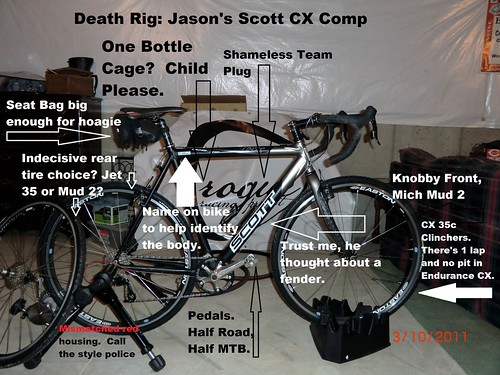
Anatomy of a Death Rig

Death Rig Jason LabeledReader Jason was brave enough to post the photo of his Sub 9 Death March Death Rig to The Best Bike Blog EVER's Facebook page.  He was the only one.  The Death March causes cyclists to evaluate everything.  Jason's running a seatbag big enough to carry a bible and a wooden stake in case of a zombie encounter at one of the cemetery checkpoints.  Personally, thinking maximum power on the roads and minimal time in singletrack, I even considered road pedals.  The test ride was unsuccessful, road pedals are not a good idea if you have to walk more than 3 steps in the mud or run from a pack of zombies and/or vampires.  Like Jason, I opted for the happy medium of Candy SL's, a platform for the road and good mud clearing.  Most readers were afraid of sharing team secrets or having their fragile cycling ego's crushed by the scrutiny of bloggers with a paint program and way too much time on their hands.  Jason, we commend you.  Now prepare for the scrutiny.


Jason, like over 150 others spent the last week matching his bike to the exact percentages of gravel, pavement, dirt road and singletrack their team plans to encounter.  Judging by the Jet Race file-treadish rear tire and knobby front, we figure Jason is making the most of the gravel roads and minimizing muddy uphill singletrack exposure.  Others planning to ride mountain bikes, will no doubt try to take advantage of the singletrack shortcuts between check points.  I will say it right now, we will likely see a road bike with 28c file treads barely clearing the fork crown and seatstays.
Right at this minute, Jason is reconsidering his rear tire choice, as noted by the extra wheel.  He may also want to take care of that mis-matched red cable housing near the rear derailluer tainting his otherwise pristine Death Rig or it will drive him nuts for 4-5 hours on Saturday.  Yeah, that was the first thing we noticed.


Good luck y'all.  For details and to register click here for the Sub 9 Death March Website.

Monday, December 20, 2010

Gift Cards b/c I Love You, But Not That Much

You want to know how I know she loves me?  My mom called and inquired whether a Challenge Griffo cyclocross tire should be size 700x34 or 700c x 34mm.  She listened to my explanation of what the “c” and “mm” meant in relation to the dimensions of the tire.  Even if faned, she seemed interested.   She’s a retired nurse.  Having administered plenty of medication, she’s no stranger to the metric system and cubic centimeters.  Even though it may’ve killed the Christmas Day surprise, I almost appreciate her effort more that the gift itself.  Obviously mom loves me way more than people she purchased gift cards for.  I’m real present worthy and they’re just gift card relatives. 

Giving a gift card is like saying I’m not interested in your life enough to get you the dorky thing you really want.  That’s why I’d rather get a real gift than a gift card.  Gift cards are like saying TMI.  I know you’re into bikes, but that’s where I’m drawing the line.  Here’s a gift card to Performance.  You do the work.

There is an exception.  The only time I like getting a bike gift card, is when it opens a little window to my life, like getting a gift certificate to my local bike shop, BioWheels, the shop I race for.  They have Bio-bucks.  Like getting a Challenge Griffo tubular, a Bio-Buck certificate from my mom says, “I know you race for BioWheels.  I know you prefer to have your sponsor’s parts on your bike.  I called and talked to Mitch the owner.  He’s a nice guy and seems like a good friend of yours.”  It's a gift with a story.  That’s a real present.  It shows interest in my life.

Real presents bring people together.  Last year my mom asked for a specific kind of water color painting paper.  I went to 2 different art stores.  I talked to the bearded hippie clerk.  Thanks to her, I now know that a block of 200 pound water color paper does not weigh more than me.  I got a taste of my mom’s hobby and she got a taste of mine.  Now, I lean in a little more when she tells me about the challenges of her painting class.  I can see how the paper and paint work together when she shows me a painting of downtown Cedarburg, Wisconsin.  In turn, at age 65, she learned a little bit about cyclocross.

The other great thing about getting a cyclocross tire for Christmas is that I can oogle it on the couch.  Try that with a gift card.  I’ll show the tire off to my science nerdy 3rd grade nephew and bore the little guy with a grand story of how fast I can ride my bike in mud.  Maybe I’ll show him a picture of me racing from my phone.  I’ll show him how the big knobbies can grab and hang on to a surface.  I'll tell him it was hand made in Belgium.  Maybe I'll point it out on a map.  I'll ask him to go ahead and touch the soft cotton sidewall, roll it across the couch cushions and explain how the cotton bends to follow the contour of the cushions.  He’ll be thrilled…for at least 3 minutes, a priceless 3 minutes of closeness with family.

Tuesday, August 4, 2009

Cyclocross Carbon Fork Brake Shudder: I’m No Engineer But I Think I Have This Figured Out

I inadvertently performed a bike experiment last night after work. I took my cyclocross bike, an Indy Fab Planet X with an Easton EC90x carbon fork for a spin at a nearby park. Since the glue job on the Zipp 404 CX tubulars was fairly new, over the past week I kept the air pressure high to make sure the glue cured and stuck to riding the roads and bike path while I dialed in the fit. Yesterday was my first cyclocross style ride with the tires at cross pressures. Instead of driving the mile to the park, I decided I’d just let some air out of the tires in the parking lot at work and ride over to the park. I guessed at it and let air out until I could squish the Vittoria file tread really good with my thumb. The ride in the park for the most part was fine, although the pressure was probably a tish too low on the hard ground. The bike felt like it was pushing to the outside in corners (as if the tire was sort of rolling under the rim.) Since my pump was a mile away, I just dialed back the cornering speed and went on with my ride. Coming down the steep road back to my car at work, I hit the brakes, and I felt the familiar tug-tug-tug of brake shudder. I could see the ends of the fork blade move. Son of a!

I had been riding this bike for at least a week and a half with the tires over 60 psi with no brake shudder. Now the tires were at the extreme opposite (guessing around 28-30-remember I let air out without a guage), probably a few PSI too low for hardpack causing a little shudder when slowing at the bottom of a paved hill. I knew about the possibility of brake shudder with carbon cyclocross forks and consequently hung on to my trusty steel fork in case this was to happen. However, I hardly think it’s time to ditch the carbon fork. You have to admit, it’s pretty rare to have a paved descent in a CX race. I didn't feel a single bit of shudder or snap while riding in the park and I even bombed a few grassy downhills where I had to brake into a corner.

It was a long hill; long enough to hit the brakes and watch what was happening. The brakes were slowing the wheel, but the tire was spinning just a bit faster. When I hit the brakes, the tires traveled a little further than the rim, causing the sidewall of the tire to give a bit and in reaction, causing the fork to flex under the bike with the grabby pressure. Ah ha!

Of course, putting the steel fork back on would reduce the shudder. But, I don’t think the problem is severe enough to add a pound back to the bike. I also think brake shudder isn’t the correct description. It’s more like fork snap. I think Carbon forks are stiffer and snappier. We all know steel has a very soft and easy flex to it. I think the steel fork flexed too, but it never snapped back to shape as quickly as the carbon. It’s like the difference between bamboo and pine. Both forks will flex under braking pressure. It’s just that the carbon fork will snap back into shape while the steel fork will flex, stay in the flexed position longer and go back to it’s original shape more slowly and less noticeably when the pressure if relieved. In addition the IF steel fork has a greater degree of rake, (48mm compared to the carbon’s 45mm). From the beginning the steel fork puts the contact area of the tire more forward than that of the Easton EC90x.

You can do a few things to minimize the “snap.” The usual fix is to try toeing in the brakes which will put less initial brake pad in contact with the rim surface, which I assume reduces initial braking power, makes braking more linear or gradual, and consequently reduce the fork flex at the other end. However, I think that’s only half, or more likely a quarter of the solution. I think tire construction, the grippiness of brake pads, tire pressure, fork rake and even the hardness of the ground play an equal role. I would go even as far to assume a tubular with a soft cotton sidewall and latex inner tube (like a Challenge or Dugast), would cause more carbon fork snap than say a Tufo or Vittoria with a thicker sidewall and standard rubber inner tube. The ground was hard yesterday, I really only needed to run low enough pressure for comfort and keep the tires from rolling in the corners. I think a few more PSI would’ve made all the difference. The other thing to note is that I didn’t feel any fork snap during the CX practice. It didn’t snap until bombing down a long paved hill.

I think the trick is to keep enough air in the tires so that they hold their shape in the given conditions. This optimal pressure will change with the course and conditions. If the tires hold their shape, that’ll give the contact patch of the tire less opportunity to get under the fork and pull it backwards. The fork snap should be reduced. Air is the least expensive of the possible combination of solutions.

Ahh. Fhew. Time to put on my smoking jacket and ease into my high-backed leather chair with a snifter of brandy.